
Quick Answer
The best shutter speed for sharp photos is at least 1 divided by your focal length, but for consistent results, you should use 2x–3x faster shutter speed. For example, a 50mm lens should be shot at 1/100s or faster to reduce camera shake.
Why Shutter Speed Matters for Sharpness
Shutter speed controls how long your camera sensor is exposed to light. The longer it stays open, the more time there is for movement — and that’s what causes camera shake.
Even slight hand movement can turn a sharp image into a blurry one.
This is why shutter speed is the most important factor in fixing shaky hands photography.
If your blur is caused by hand movement, start here: How to Fix Shaky Hands Photography
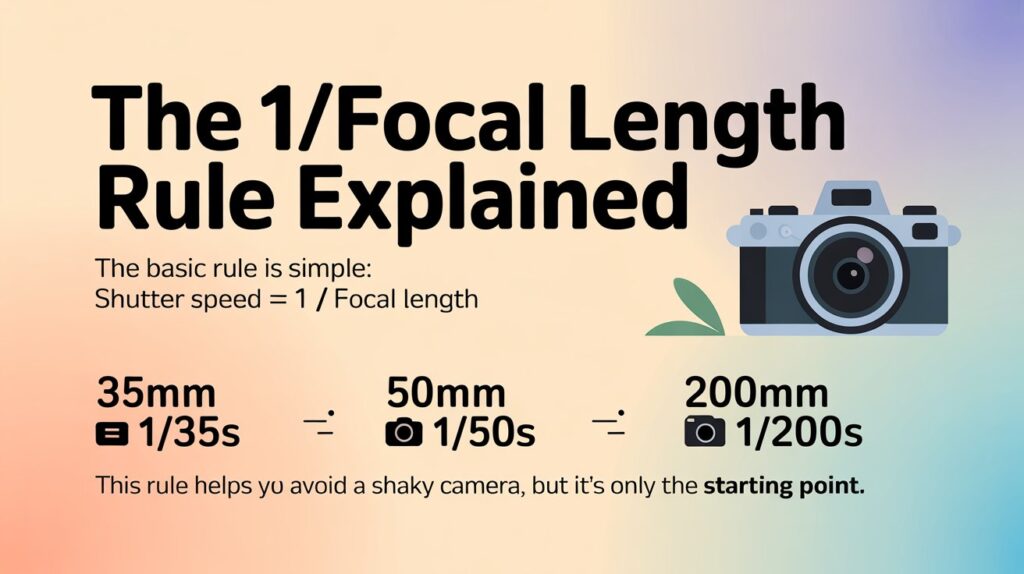
The 1/Focal Length Rule Explained
The basic rule is simple:
Shutter speed = 1 / focal length
Examples:
- 35mm → 1/35s
- 50mm → 1/50s
- 200mm → 1/200s
This rule helps you avoid a shaky camera, but it’s only the starting point.
Why This Rule Is Not Enough
In real-world photography, this rule often fails because:
- Modern cameras are high resolution
- Hand movement is underestimated
- Zoom lenses amplify shake
- People don’t hold the camera perfectly steady
That’s why professionals go faster.
The Real-World Rule (What Actually Works)
For sharper results:
- Use 2x shutter speed → safe
- Use 3x shutter speed → very sharp
Example:
- 50mm → 1/100 or 1/150
- 200mm → 1/400 or higher
This is one of the most effective ways to reduce camera shake and blur in photos.
Different Solutions For Best Shutter Speed for Sharp Photos
📸 Daylight Photography
- 1/200 – 1/1000
- No camera shake issues usually
🌙 Low Light Photography
- 1/60 or slower (risky handheld)
- Use tripod or monopod
🏃 Action Photography
- 1/500 – 1/2000
- Prevent motion blur
🔭 Zoom Lens (Telephoto)
- 1/300 – 1/1000+
- Shake is amplified
How to Increase Shutter Speed Without Ruining Exposure
To maintain brightness:
- Increase ISO
- Use wider aperture
- Add more light
This is how you balance sharpness vs exposure
Common Mistakes to Avoid
- Using 1/60 for all situations
- Ignoring focal length
- Trusting stabilization too much
- Shooting slow shutter handheld
Final Tip
If your photo is blurry, the first thing to fix is always:
Increase your shutter speed
1 thought on “Best Shutter Speed for Sharp Photos (Complete Guide for Zero Blur)”