
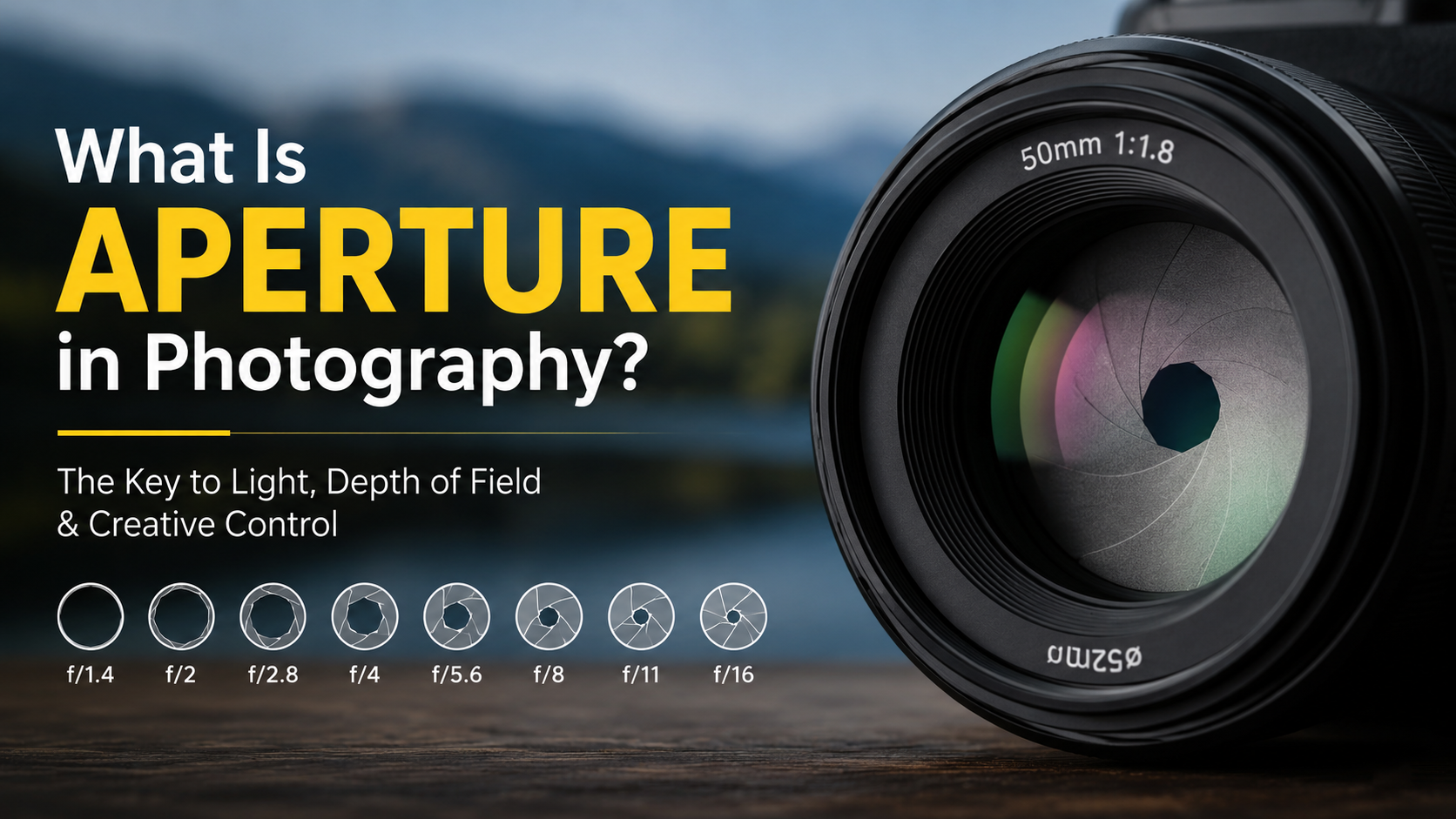
The complete beginner’s guide — from f-stops and depth of field to exposure and the best settings for every situation.
In this guide
- What aperture actually is
- How f-stops work
- Aperture and exposure
- Depth of field explained
- Interactive aperture demo
- The exposure triangle
- Best settings by situation
- Common questions answered
What aperture actually is
Aperture is the opening inside your camera lens through which light passes on its way to the sensor (or film). Think of it exactly like the pupil of your eye — it widens in dim light to let more in, and narrows in bright light to restrict it. Your camera does the same thing, except you control it.
Inside every lens is a set of overlapping thin metal blades called the diaphragm. These blades move to create a roughly circular opening of adjustable size. When you change the aperture setting, you’re changing the diameter of that opening.
Key concept: A larger aperture opening lets in more light and creates a shallower, more blurred background. A smaller aperture lets in less light and keeps more of the scene in sharp focus — from near to far.
Aperture is one of the three pillars of exposure in photography — alongside shutter speed and ISO. Mastering it gives you creative control over two of the most important qualities in a photograph: brightness and depth of field.
How f-stops work — and why the numbers seem backwards
Aperture is measured in f-stops — written as f/1.4, f/2.8, f/8, and so on. The “f” stands for focal ratio: the focal length of the lens divided by the diameter of the aperture opening.
“The larger the f-stop number, the smaller the physical opening — because you’re dividing by a bigger number.” — Why f/16 is a pinhole and f/1.4 is a wide gateway
This is the single most confusing thing for beginners: f/2 is a bigger hole than f/16. The easy way to remember it — treat the f-number like a denominator in a fraction. ½ is larger than 1/16, so f/2 is larger than f/16.
| F-stop | Opening | Light admitted | Typical use |
|---|---|---|---|
| f/1.4 | Very wide | Maximum | Low light, portraits with strong bokeh |
| f/1.8 | Wide | Very high | Portraits, indoor photography |
| f/2.8 | Wide–medium | High | Events, weddings, low-light zoom work |
| f/4 | Medium | Moderate | Travel, street, versatile zoom lenses |
| f/8 | Medium–small | Lower | Landscapes, architecture, product shots |
| f/11 | Small | Low | Landscapes, maximum sharpness zone |
| f/16 | Very small | Very low | Bright exteriors, max depth of field |
| f/22 | Pinhole | Minimum | Star-burst sun effects, macro details |
Each full f-stop step either doubles or halves the amount of light entering the lens. Moving from f/4 to f/2.8 doubles the light; moving from f/4 to f/5.6 halves it. This relationship is why aperture, shutter speed, and ISO can be traded against each other predictably — they all work in stops.
Aperture and exposure — controlling brightness
The most direct effect of aperture is on exposure — how bright or dark your image is. A wide aperture (small f-number) lets in more light, producing a brighter image. A narrow aperture (large f-number) restricts light, producing a darker image.
In practice, you rarely adjust aperture in isolation. Changing it requires compensating with shutter speed or ISO to maintain correct exposure. Shoot wide open at f/1.8 outdoors on a sunny day and you’ll almost certainly overexpose — so you’d either raise the shutter speed or use a neutral density filter.
Aperture priority mode (Av or A)
Most photographers use Aperture Priority mode — labelled Av on Canon bodies, A on Nikon and Sony — which lets you set the aperture while the camera automatically selects a matching shutter speed. It’s the most practical mode for portrait and street photographers, because you stay in control of depth of field while the camera handles exposure math.
Depth of field — aperture’s creative superpower
Depth of field (DOF) refers to how much of your scene appears acceptably sharp, from nearest to furthest. Aperture is the primary control for depth of field — wider apertures produce shallow DOF (blurred backgrounds), narrower apertures produce deep DOF (sharp backgrounds).
The blurred, out-of-focus quality of the background is called bokeh (from the Japanese word for blur). Photographers prize smooth, creamy bokeh in portrait work — achieved by combining a wide aperture with a long focal length and a subject close to the camera.
Three factors that control depth of field
Aperture isn’t the only variable. Depth of field is determined by three factors working together:
- Aperture — wider (lower f-number) = shallower DOF
- Focal length — longer (e.g. 200mm) = shallower DOF than short (e.g. 24mm)
- Subject distance — closer to camera = shallower DOF
This is why a 50mm lens at f/1.8 close-up to a portrait subject delivers beautiful background separation, while the same aperture on a 24mm wide-angle lens at the same distance produces noticeably more depth.
Struggling with blurry shots? Check out our guide on how to fix shaky hands in photography to capture sharper images.
The exposure triangle — aperture’s two partners
Aperture never works alone. Every exposure decision is a negotiation between three settings — the exposure triangle:
- Aperture — controls light volume and depth of field
- Shutter speed — controls light duration and motion blur
- ISO — controls the sensor’s sensitivity to light and digital noise
When you close down aperture to get a sharper landscape (say, from f/4 to f/11), you’re admitting less light. To maintain the same brightness, you either slow the shutter speed (risking camera shake or motion blur) or raise the ISO (risking digital noise). Understanding this trade-off is the foundation of creative exposure control.
Best aperture settings by situation
There’s no single “correct” aperture — the right choice depends on what you’re shooting and what effect you want. Here’s a practical reference:
🎭 Portraits — f/1.4 to f/2.8 Wide aperture separates subject from background with smooth bokeh. f/1.8 or f/2 hits the sweet spot — sharp eyes, creamy background.
🏔 Landscapes — f/8 to f/11 Narrow aperture keeps everything sharp from foreground rocks to distant mountains. Avoid f/16+ to prevent diffraction softness.
🏙 Street photography — f/5.6 to f/8 Mid-range aperture gives enough depth of field to capture sharp candids while still working in variable light conditions.
🌙 Night / low light — f/1.4 to f/2.8 Wide open to maximise light gathering. Combine with a raised ISO and slow shutter (with IS or tripod) for clean night exposures.
🌸 Macro / close-up — f/8 to f/16 At close focusing distances, depth of field collapses dramatically. A narrower aperture recovers enough sharpness across the subject.
🏃 Sports / action — f/2.8 to f/4 Wide enough to allow fast shutter speeds in variable light, with enough depth to track a moving subject without losing focus.
Common questions answered
Does a larger aperture always mean better image quality?
Not necessarily. Most lenses perform best slightly stopped down from their maximum aperture — typically 1–2 stops. An f/1.4 lens often produces its sharpest, most contrast-rich images at f/2.8 or f/4. Wide open, lenses commonly exhibit vignetting (darkened corners), chromatic aberration, and reduced sharpness. Knowing your lens’s “sweet spot” is part of understanding your gear.
What is diffraction, and why does it matter?
At very small apertures (f/16 and beyond), light waves passing through the tiny opening begin to spread and interfere with each other — a phenomenon called diffraction. This reduces image sharpness even though you’re stopping down for more depth of field. Every sensor has a diffraction limit, and for most modern sensors, f/11 is the practical maximum for optimal sharpness.
Can I change aperture on any camera?
If you shoot in Auto mode, the camera controls aperture for you. To set it manually, use Aperture Priority (Av/A) or Manual (M) mode. On smartphones, most native camera apps don’t offer aperture control — the lens aperture is fixed — but third-party apps like Halide or Camera+ expose shutter and ISO controls.
What does “fast lens” mean?
A fast lens is one with a wide maximum aperture — typically f/2.8 or wider. The name comes from the fact that a wide aperture allows faster shutter speeds in low light. Fast lenses are prized for low-light performance and portrait bokeh, but come at a premium price and weight.